
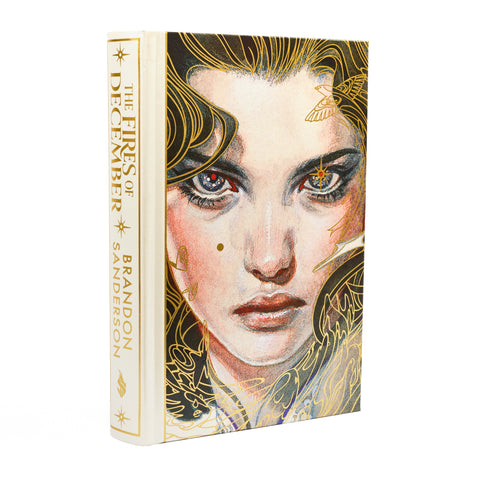
Brandon Sanderson's newest novel, The Fires of December, is now available in ebook and audiobook formats. Get December's story for yourself through Macmillan publishers before the physical release this December. You can also check out sample chapters here on The Cognitive Realm.
Kill the Elves
In the decades that followed Tolkien’s The Lord of the Rings, the fantasy authors of the 20th century took one of two paths: they invented new fantasy landscapes, or they put their own spins on Tolkien’s staples—elves, dwarves, quests, and the like. Tolkien’s beloved shadow continued to loom when young Brandon Sanderson was breaking into the industry. While working for a university magazine, Brandon wrote an essay called “Kill the Elves.” Not long after, he published an article called “How Tolkien Ruined Fantasy.” His conclusion: “Tolkien was so good at what he did that we all ended up copying him for a long time.”
During the first years of his career, Brandon veered away from this Tolkienesque tradition and focused his epic fantasy on human stories. Though his stance against classic fantasy creatures has softened, even these days his creatures lean toward humanity, though each invention finds its place in the intricate cosmology that has helped make the Cosmere the home of some of fantasy’s favorite worlds. Let’s take a look at some of the strange creatures of the Cosmere!
Worldbuilding details and creature designs for books in the Cosmere will be prevalent here. If you feel like those details are close enough to spoilers to raise your eyebrows, consider revisiting this article after you’ve read Elantris, Mistborn, and the first three books in the Stormlight Archive.
The Creatures of the Cosmere
Elantris
Since the very beginning, each of Brandon’s epic fantasy novels has brought new creatures to the Cosmere. Elantris introduced seons, floating balls of sentient light that serve human masters. Seons are closely tied to the magic of Sel, where they function as integrated parts of everyday life, performing the roles of telecommunications devices, covert scouts, and counselors. A seon can also be passed from one human to another, and their service is inspired by devotion rather than compulsion or dominion. And in true Sanderson fashion, the seons are not exempt from the consequences of the world's magic. When the Reod claimed the Elantrians, it also claimed their seons, who spent the next decade drifting aimlessly through the city.

Mistborn
Mistborn brought its own creatures to the table and deepened the interconnectivity between world, character, and magic system that Brandon had introduced with seons. For example: On one of Kelsier’s first nights training Vin, he shows her a mistwraith, a chimeric, moving mass of eclectic body parts. Their transparent skin reveals a skeleton that consists of human and animal bones in a complex patchwork, inelegant but functional. Skaa folklore warns children to hide from the mists, lest a wraith consume and replace them, similar to changelings in European folklore. But Vin observes that they’re actually harmless, scavenging bones and tissue off dead animals in the wildernesses of the Final Empire. Though their appearance is nightmarish, they are peaceful abominations.

The next creature introduced in Mistborn is the kandra, a shapeshifting race that can wear the bones and faces of the dead. Kelsier uses them as a key part of the thieving crew, and the skaa are understandably skeptical of his methods and the kandra’s role in the plan. The kandra play a key role in the events of the trilogy, and the connection discovered between mistwraiths and kandra is one of the first peeks Brandon gives his readers at the interconnectivity that exists between the many races of the Cosmere.

Koloss add a layer of ghoulishness to the Final Empire. Hulking monsters who prize violence and strength, the koloss are an army that the Lord Ruler holds in reserve, like attack dogs frothing at the mouth as they strain against their leashes. When the koloss are allowed to raid, there are barely ruins to pick through in the aftermath. Their monstrous personalities match their appearance, which includes blue skin that stretches and breaks, leaving eternally bleeding sores all across their bodies. Add their colossal greatswords and you’ve got a raging force of chaos and destruction that will strike fear into the pluckiest skaa rebel.

Inquisitors are the books' first hint that its monsters are related to humans. With spikes driven through their eyes and bodies, grating voices, inhuman strength and speed, and allomantic capabilities, they form the secret police of the Final Empire, hunting down potential allomancers and doing the Empire’s dirty work. Their spikes are our first glimpse of hemalurgy, a magic system closely tied to all of Scadrial's creatures.

The planet Scadrial had other amazing creatures, but cataclysmic events that occurred during the Lord Ruler’s rise to power created a harsh environment of ashfall and mists that choked a lot of the wildlife. Thankfully, the return to a healthy orbit before Wax and Wayne’s time helped restore the natural order and bring a lush resurgence to the planet.
The Stormlight Archive
The Stormlight Archive brings us two more types of Cosmere creatures: the crustaceans native to Roshar, and the spren.
Roshar is a harsh world ravaged by storms and features many diverse ecosystems, from the idyllic Purelake to the wartorn Shattered Plains. The creatures of Roshar are well equipped to survive the highstorms. The endemic species are crustacean, though human involvement has also bred species with familiar traits: axehounds bred for doglike loyalty and hunting prowess, and chulls as unstoppable draft animals.

Meanwhile, some wild and savage species benefit from spren bonds and tough carapace. For example, the crustaceans that the Rosharans classify as “greatshells” are so large that they should crush themselves under their own weight, but they receive gravitational assistance from arrowhead-shaped luckspren. Chasmfiends, are greatshell apex predators who lurk in the shadowed canyons of the Shattered Plains until they emerge to pupate. Almighty preserve the enterprising highprince who dares raid the pupae for their valuable gemhearts! Other greatshells like the Tai-na are so enormous that island-dwelling humans build villages atop them while the Tai-na wander across the northern seas of Roshar. Symbioses like what exists between luckspren and greatshells are found all across Roshar.

With the invention of spren, Brandon demonstrates his mastery over worldbuilding interconnectivity. Spren are like manifestations of feelings, natural phenomena, and ideas. From the rare burst of gloryspren, the shattered glass appearance of shockspren, or the grasping miniature hands of painspren, they are a part of human life wherever they go. Often incorporeal, spren are part nature spirit and part cognitive being, and their existence in the physical world is mirrored by a native shape that they take only in the Cognitive Realm.

Spren that appear alongside emotions and events (like the aforementioned gloryspren, painspren, and rotspren) are counterparts to the sentient spren, who can bond with humans. These bonds grant greater sentience and growth to the spren and fabulous powers to the budding Knights Radiant. Even after five Stormlight novels, every return to Roshar reveals more about the spren and the planet’s other amazing creatures.

Doing Demons Differently
The Fires of December is the next book coming to the Cosmere, with the ebook and audiobook releasing on October 6 and the physical release coming in December. Like most of Brandon’s novels, it introduces new creatures, and these ones are called “demons” by the people of the planet Miral. The first demon is a humanoid colossus left in stasis after a hero long ago pierced him with an ever-slaying sword. From that demon, a profusion of blood flows in three rivers that sustain the kingdom and out of which crawl the other demons: small, animal-like creatures. These demons, though distinct from the giant demon body found in the kingdom’s capital, suffer under the superstitions it caused.


The book is brand new so I won't spoil how these demons factor into the world building or story any deeper here. These little animal demons are ever present, and they serve as the chapter ornaments in addition to their role in the events of December's journey. One demon in particular, a cat with molten tears streaming from its eyes, even gets its own spread in the novel (illustrated by the incredible Tran Nguyen).
If December is any indication, Sanderson’s worldbuilding success wasn’t a flash in the pan—it was the result of a thoughtful, intentional approach to fantasy writing and a testament to what is possible in a genre without limits. If you want to get a copy of The Fires of December for yourself, the ebook and audiobook will be available on October 6th. Physical copies will be available starting this December if you missed the preorder.

Owning the Creatures You Create
With these bespoke and ingenious creature designs, Brandon has crafted a tapestry of worlds where tiny spren and eldritch gods are all active participants in the Cosmere’s magic systems. The ecologies of planets depend on and change with them, and entire civilizations can rise out of their cognitive carcasses. These creations have become beloved hallmarks of modern fantasy.
You won’t find elves or dwarves between the pages of a Brandon Sanderson novel. What you will find are thoughtfully constructed creatures, with decades of literary history and intentional interconnectivity breathing life into them. And, of course, dragons.
Sanderson has raised the bar for writers and worldbuilders. But what do you think—should this article be titled “How Sanderson Ruined Fantasy”?

 https://www.dragonsteelbooks.com
Comments (0)
There are no comments for this article. Be the first one to leave a message!