
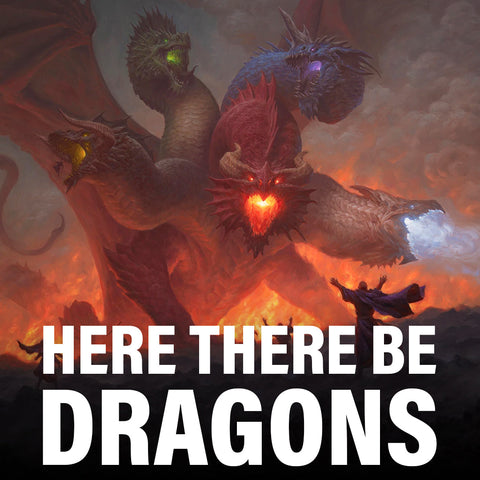
Enter the Dragon
People tell stories for many reasons. We recount humorous experiences, harrowing tales, and accounts of adventure and excitement. Around the world, people have different storytelling traditions, mediums, and of course, languages. But one thread remains consistent worldwide and throughout history: a thread of fire-breathing, wish-granting, flying reptiles. A thread of dragons.
Accounts and depictions of dragons are as varied as the dragons themselves. In Beowulf we read about a fire-breathing serpent, jealously guarding his treasure and avenging himself when that treasure is stolen. Fafnir the dwarf is transformed into a dragon in Norse myth. One of Hercules’s trials is to confront the dragon Ladon in the garden of the Hesperides, stealing its golden treasure of apples. The Mesopotamian goddess Tiamat took the form of a dragon, who is slain with an arrow through the mouth and whose body is then split to form the heavens and the earth. Chinese mythology tells of four dragons who bring rainfall and life-giving water to the ancient people.
Sometimes they are benevolent; other times they are destructive and deadly. They are always exciting.
What Is a Dragon?
One cannot read about, watch, draw, or fight dragons for long before someone pipes up with the inevitable: “Um, actually, that’s not a dragon. That’s a wyvern.”
Dragons, drakes, wyrms, wyverns, and more are all names given to different classifications of fantasy fauna. These distinctions have their roots in medieval heraldry, where a four-clawed, two-winged dragon was something different from a four-limbed wyvern. Both were animals that might grace coats of arms, alongside other beasts mundane or magical. You might see a dragon, a wyvern, a cockatrice, a lion, or any of a menagerie of creatures gracing a knight’s heraldry.

In Western mythology, a “true” dragon has two wings, two legs, and two arms, while a wyvern has only two wings and two legs. Eastern dragons are characterized by lionlike features, long and winding bodies with no wings, and twisting mustaches. Over the years, these distinctions have remained in place, though storytellers around the world borrow different dragon designs for different purposes. An anime might use a design like the twisting, Eastern design of Dragon Ball's Shenron, the European fantasy design of the Solar Dragon in Frieren: Beyond Journey’s End, or the unique, grounded design of the red dragon from Delicious in Dungeon. Likewise, Western RPGs like Dungeons & Dragons might introduce dragons with features pulled from either artistic tradition.


Dragons in English Literature
Beowulf’s confrontation with the dragon is one of the foundational moments in early English literature and was a structure J. R. R. Tolkien borrowed for The Hobbit. Smaug bears many similarities to his elder cousin, from jealously guarding a horde of treasure to exacting vengeance against those who seek that treasure or, rather, steal their golden cups.
The dragon is the swan song of Beowulf’s career, the monster who costs the hero everything. The creature itself is a vengeful monster, punishing the whole kingdom for a peasant’s theft of a golden cup. It represents death, begets sacrifice, and gives Beowulf a chance to show he has become the king who can save his people.
Then Beowulf came as king this broad
realm to wield; and he ruled it well
fifty winters, a wise old prince,
warding his land, until One began
in the dark of night, a Dragon, to rage.
Tolkien’s Smaug is an homage to Beowulf’s foe, punishing Lake Town after Bilbo takes a piece of Erebor’s treasure back to Thorin. Smaug is characterized through his assault on the dwarves and then through his interactions with Bilbo the burglar. The conversation between Bilbo and Smaug is as colorful a confrontation as the eventual fight that fells the wicked wyrm.

More 20th-century authors wrote about dragons, but the next shift in English-language literary culture came through Anne McAffrey and The Dragonriders of Pern. In McAffrey’s novels, dragons and their riders form a telepathic bond and work together to stave off world-ending threats—er, threads. McAffrey’s dragons have inspired many dragon–rider team-ups since, from Paolini’s Eragon to Cahill’s The Bound and The Broken, Yarros’s Fourth Wing, and even Cowell’s How to Train Your Dragon. McAffrey’s legacy has permeated fantasy beyond just influencing other authors: the Githyanki, a race from Dungeons & Dragons, are dragon-riding astral raiders. A frequent trope in Pokémon includes riding your Charizard or a similar companion between in-game locations. Every dragon appearance now comes with a chance for an eventual team-up. Despite these friendlier dragons, dragons as destructive and deadly foes never go out of style.
The ubiquity of dragons even led to entertaining taxonomical reference texts, teaching young dragon enthusiasts about the various histories, biologies, and classifications of dragons. How-To-Draw books and dragon encyclopedias helped popularize wyvern/dragon distinctions and introduced a generation of artists to more dragons.

Dragons On-Screen
Dragons have remained a staple of fantasy literature since Tolkien, and with the translation of the fantasy genre to new media, dragons too have been translated. The 1980s saw many dragons on-screen through the magic of puppetry and the dawn and growth of special effects. Many of these campier dragons remain fan favorites decades after their introductory appearances: Falkor the Luck Dragon from The Never-Ending Story and Draco from Dragonheart to name a pair.
As special effects got better, dragons got more dangerous and more impressive. From Reign of Fire to Monster Hunter, dragons in live-action movies have become spectacular foes boasting incredible special effects. Harry’s confrontation with the Hungarian Horntail in The Goblet of Fire and Bilbo’s 2013 face-to-face with Smaug were both elevated by motion capture and the rising quality of computer imagery.


Game of Thrones also boasted great-looking dragons, with The House of the Dragon taking them to even greater heights. With Daenerys’s initial hatching of her wyrmlings, the mounted escapades of the early history Targaryens, and Drogon’s war crimes in later seasons, the dragons of Westeros are a sight to behold.
Animated dragons often bring life and artistry to the stories that they are a part of: From the protector of Fiona’s castle in Shrek to Toothless the Night Fury in How to Train Your Dragon, animated dragons are full of character and heart. With Shrek 5 and a second live-action How to Train Your Dragon coming soon, these beloved icons are here to stay. Both video games and animated movies feature dragons crafted by teams of animators, and through their artistic talents, dragon lovers enjoy a wide range of cute and killer animated dragons.
Dragons In-Game
Tabletop Roleplaying Games
Since Dungeons & Dragons launched in the 1970s, dragons have guarded treasure from questing adventurers, and they’ve helped motivate heroes by stealing sheep and the occasional villager. Dungeons & Dragons and Anne McAffrey both utilized color-coded dragons with different abilities: D&D dragons are split into good-aligned metallic and evil-aligned chromatic dragons. Red dragons breathe fire, blue spit lightning, black spew acid, white spray ice, and green hiss poison. Each element is represented equally on both sides of the alignment spectrum depending on the sheen of the scales.
Video Games
Games like D&D inspired the first generations of video game developers, and the dragon DNA is strong throughout the last forty years of gaming history. In the Super Nintendo era, fights against dragons were cinematic, with complex enemy sprites and behaviors allowing you to dodge fireballs and claws while you blast boss monsters until they pop.

In the next gaming generations, dragons were both enemies and protagonists. Spyro puts the player in control of a baby dragon, blasting enemies with fire breath and gliding on fledgling wings. Spyro’s attitude and charm helped him find a place in the crowded world of turn-of-the-century gaming mascots.
Pokémon has an entire dragon type, with some of the franchise’s strongest monsters represented here. Iconic champions like Lance and Cynthia challenge trainers with potent companions like Dragonite, Garchomp, and Charizard. These monsters were so strong that a new fairy type was introduced to counter them.
Graphics got better, and dragons became even larger in scope and scale. Skyrim brought the Elder Scrolls series’s extinct dragons back from the dead, creating a new generation of dragon boss fights. The hero of Skyrim is the Dragonborn, a mortal born with a dragon’s soul and an ability to speak the dragon language to channel powerful spells. This made every combat against a dragon into an expansion of the hero’s spellcasting abilities.
Dark Souls and a number of FromSoft’s sequels feature climactic boss fights against dragons of many shapes and sizes. The scale of the immense beasts lends a sense of frantic survival to each fight, when your moment to strike is punctuated by losing line of sight on the ferocious monster intent on your annihilation. The endgame of these titles often includes an impressive dragon: Dark Souls has Seathe the Scaleless, Dark Souls 3 has Darkeater Midir, and Elden Ring has Dragonlord Plasidusax. Each fight brings an incredible foe to bear against the player.


Dragonsteel Picks
Team Dragonsteel is an eclectic mix, with diverse appetites for all things draconic. We asked a few members of our team about their favorite dragons, and the array of answers we received surprised even me.
My Favorite Dragon: Tiamat, the Queen of Evil Dragons
Few powers can challenge a D&D adventuring party at the 20th level. Few, however, does not mean none. Dragons in Dungeons & Dragons are some of my favorite, and Tiamat is the ultimate dragon in the D&D universe: a five-headed tyrant bound to the Nine Hells until an adventuring party reaches such a high level that the dungeon master plucks her from her infernal prison and slams her on the tabletop. With five heads, she has five breath weapons, five bite attacks, and the combined cognitive abilities of five ancient wyrms. She is an apocalyptic threat for any band of plucky heroes.

A generation of dungeon masters learned how to run the game through the 2014 campaign Tyranny of Dragons, which pitted players against a cult dedicated to Tiamat and culminated in a ritual to summon her. With recent appearances in Secret Level on Amazon Prime and as a card in Magic: The Gathering, she continues to find new audiences and new victims.

I’ve spent years running D&D for my friends, and their inevitable confrontation with Tiamat looms ever closer. Let me know who your favorite dragon is in the comments below this post!
When the Smoke Clears
Dragons aren’t going anywhere. Fourth Wing just brought a resurgence to mainstream fantasy literature, and the Bound and the Broken series is an indie success story for the ages. The winged villains are appearing in greater numbers in the Cosmere, and the next suite of blockbuster video games is sure to include the biggest and baddest dragons yet. We’re sure to witness more conversations, classifications, and debates about the greatest dragons of all time. One thing is certain, though: When the smoke clears from any nerd argument or deep lore discussion, here, there be dragons.

 https://www.dragonsteelbooks.com
Comments (5)
Tiamat’s pretty awesome, but so is her counterpart, Bahamut. Love the D&D references!
Love this article! Although I would also like to add that with the classification of dragons you described, you also argue that the Toruk and the banshees from AVATAR (blue people AVATAR) could also be considered dragons.
This is a sick article Jack! Love the depth you brought to dragon lore. My favorite dragon is either Rayquaza from Pokémon or Thorn from the Eragon books, especially after reading Murtagh!
Thank you!!! Great!! I loved this.
Yes, dude, another Jack passion project