
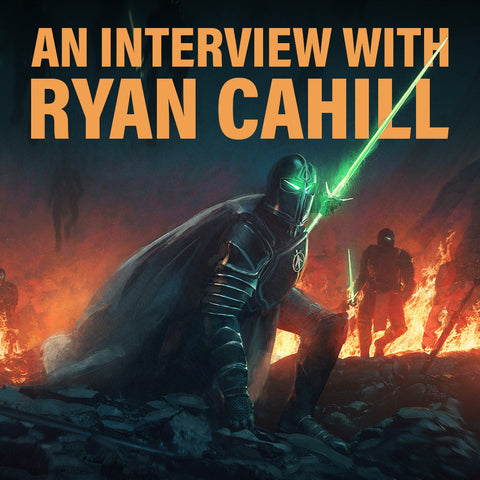
Introduction to Ryan Cahill
Ryan Cahill’s dragons are like his fantasy: deadly, grounded, and deep. The Bound and the Broken is his series of epic fantasy novels, chock full of dragons, magic swords, and tearjerking character moments. The series plays out through a world where the dragons and dragon riders were once guardians of the people, but now serve an oppressive imperial regime. That empire rules with an iron fist and threat of dragonfire, leaving the people to rally behind rebel heroes.
I read Of Blood and Fire, Ryan Cahill’s debut novel, after his panel appearance with Christopher Paolini at DSNX last year. The first book drew me in, and I quickly devoured the series. Ryan is working on the fifth book now, and I can hardly wait to sink my teeth into it.
Cahill just released a premium edition of The Fall, the first novella in The Bound and the Broken series, and the book release brought him to Utah, where he shared an evening on stage with Robin Hobb and Brandon Sanderson.

The Bound and the Broken Series
The story follows Calen Bryer, the first free dragon rider or “draleid” in three hundred years. Familiar ground like coming of age trials, quests for dragon eggs, cities of elves and dwarves, and the like, give a cozy start to a series—but don’t settle in. It doesn’t take Ryan long to introduce the conflicts that set this series apart. There are currently four novels and three novellas, each expanding the history, background, magic systems, and character depth that Of Blood and Fire set off.
From the time Calen and his companions leave their home village, they are sent running for their lives through a story that doesn’t pull punches. Their world is neck-deep in a centuries-old war, and the series doesn’t shy away from darker themes. It’s gritty and at times can be grim, violent, and mature. He uses his characters to create a portrait of what good people can do in a hard situation. Their relationships with each other and with their world have made these characters some of my new favorites. I love watching the struggles between good and evil, and between the powerful and the powerless. The cast that surrounds Calen is colorful and helps fill the world and story with different perspectives on grief, war, and heroism.
There is a lot to love about this series, and I highly recommend it to anyone who likes reading about dragons, dragon riders, soldiers in power armor, faction politics, or intricate magic systems.

Interview with Ryan Cahill
I got to chat with Ryan recently, and ask him about his writing, his world, and what makes a hero.
Why Dragons?
Jack: Ryan, you’ve said before that you set out on your career as an author with three rules for yourself: One, write the book that a younger you would be proud of writing. Two, write the book that you want to read. And three, it must have dragons. Why dragons?
Ryan: They’ve been a massive part of my journey as a reader. The first book I ever got was Scholastic’s The Big Book of Dragons. Then I got into the Dragonriders of Pern with Anne McAffrey, and I read some of Eragon and The Inheritance Cycle, and I also read the Temeraire series by Naomi Novak, which was massive for me. Something that has stuck with me is that in different generations, dragons are symbols of different things. As you go back to the Tolkien era, you have dragons who hoard gold, dragons who are all powerful, with brain and wit and they speak. In The Hobbit, the dragon is a symbol of wealth and greed and what happens when you are greedy. As you go to medieval times, the dragon is the fear to be slayed, the opposition.

When you come into my generation and your generation, dragons started to symbolize something completely different: a bonded pair. Anne McCaffrey kind of led that, and then again, Naomi Novik and Christopher Paolini, and there’s been a lot of other examples from long ago all the way up to now. [I love] this idea that dragons are a symbol of connection. Something that we all look for, and we all strive for, but that’s not possible to find in the real world is a partner, a thing, or a person that just knows when you need them. They know when you’re sad, or when you’re happy, when you’re angry, and they know how to fix it, and they’re always there, and there is a complete, perfect connection that we’ll always strive for.
So I think there’s something incredibly magical in that when people read it, and they say, “Man, I want that feeling.” And the closest we ever get to it is like a dog. You might have a dog who just knows you. When you’re sad the dog just knows. The dog knows what happened. And the dog doesn’t care why you’re sad. They’ll just be there.

Writing Grief
Jack: A dragon rider or a dragon who loses their partner becomes rakina. In your books, rakina are a rare breed, because that loss is often fatal and you’ve talked in other interviews about the dual meaning of rakina: one who is broken or one who survived. How do you approach writing a relationship that affects someone in that way?
Ryan: For me, the whole idea was born from surviving through grief, and the idea that a lot of the time when you have a huge loss that can’t be equated to. A lot of my readers who've reached out to me have lost children, lost brothers or sisters, or close friends, or mothers and fathers. You kind of have to learn to be a new person. When you lose someone that is so ingrained in everything that you’ve ever known, when you lose a parent, after you’re so used to always having that North Star, always having that pillar there and you have to learn how to be a new person. You have to find the confidence you never needed to have because they had it for you.
And when you lose a son or you lose a daughter or you lose a partner, again, you have to accommodate this new life and learn to be a new person. There was something when I was writing these characters that I wanted to try and really, really find. These characters all had something different that they lost. As you read some of the novellas, especially The Ice, you can understand how the person and the experiences they have will affect what is broken, because nobody breaks in the same way. They all lose different things. Farda lost his ability to care. He became apathetic. He lost his ability to feel pain. [Different characters lose] other things. We all deal with grief differently. We all have to walk different paths, so we all lose different things when we lose people. So it was kind of like a way I wanted to bring that into the series without standing on a soapbox and telling people how to feel. I wanted instead to explore it through character and to say “Okay, how about we explore it as a journey?” I would explore it as these people trying to find purpose again, trying to find a way to stand on their own two feet after incredible loss.
Jack: Who is Ryan Cahill’s favorite dragon?
Ryan: Who’s my favorite dragon? There are a few that I would jump to, and one of them is a film you might not have seen. It’s an older film, even for me, called Dragonheart. That was one of my first proper exposures. And I’ll always have these memories of Draco peeling open his chest. If I’m trying to be honest to go back and not just pick the big ones, it would be Draco, and it would have been like Falkor. I view Falkor as a dragon, I absolutely do. Also Temeraire from His Majesty’s Dragon is absolutely [great]. I remember reading the first book of that series and then my friend coming back and saying, “There’s more books!” They will always be probably my favorites.
There are many that I love, but these are my favorites. I have a soft spot for Viserion from the Game of Thrones books, and not the Viserion from the show because his personality doesn’t translate.

Um, Actually, That’s a Wyvern
Jack: You can’t go far in the world of fantasy without the inevitable, “Um, actually, that’s not a dragon, that’s a wyvern.” In Epheria, you have dragons, wyverns, wyrms, and other monsters like the n’aka. What do you enjoy about writing different types of dragon-like creatures?
You’ve invented a few and you have your own spin on some of these things. Your dragons are absolute war machines, you know, dragon fire burns thousands on a battlefield. They can slam their tails, smash with their claws, whatever it is. What do you like about telling stories that feature such a broad dragon cast?
Ryan: I knew what was gonna happen when I made my dragons the way I did, and so I explicitly put wyverns in the world so people could just deal with it. I love dragons of all shapes and sizes, give me the four-legged dragons with the two wings, [give me all of them]. When I look at culture across the world, and you look at Quetzalcoatl from South American culture or the Feathered Serpent God, or your Chinese culture, where you have the flying dragons without wings.
I’ve always found it really funny when people say “No, no, dragons, four legs and two wings, and nothing else.” [I have to laugh and say] actually, that’s just according to Wales. What I wanted to do is a really similar thing to how George R. R. Martin approached dragons. These creatures are the most amazing, incredible, fantastic creatures in the world. They require every piece of suspension of disbelief in your brain. The problem there, when you’re telling stories, if you want to create a setting that feels grounded as opposed to completely high fantasy, you’ve just used all your suspension of disbelief points on the dragon. That’s how I view it.
For me, having the dragons with two winged forelimbs and two legs allowed me to take away some of the suspension of disbelief, because people already have real world examples of how those creatures would walk and how they would fly. We don’t have to think what their other body parts would be doing. There’s no disconnect there.
There’s other parts of the world that get introduced. These gene pools are all across the world, so there’s different types of creatures, different variations, exposed to different stimuli around the world. There’s my chemistry background coming in, forcing them to have different types of evolution and growth. It’s been really cool, really fun. I love coming up with some of those. Like having the wyverns and having the dragons is one thing, but then introducing the wyrms and the n’aka and these different types of creatures and seeing [their biology might work] has been really enjoyable. It’s been really cool to try and cope with a few things that are completely new. And I really enjoy seeing how the characters will face them or also just seeing what kind of environments they’d live in and how they’d react to invaders, to food sources, or lack of food.
Discovering Epheria
Jack: Is there anything that you discovered about Epheria, as you were ideating, that you didn't expect to then write about?
Ryan: I think questions are the best things ever. Someone posed the question, “how do books work in your world? You don’t have the Gutenberg printing press? How do books work? And why aren’t books worth the same price as a horse?” And so when I was going back through it, I recognized that I needed to find a reason for that. And, you know, I went back through, and I was able to invent a branch of the crafts mages called the excendi, who are essentially human printing presses. They use their magic, they use the spark, essentially, to mimic a page. They’ll take a page and they can weave the threads through the pots of ink they have, and they can create. They spend years and years trying to make exact copies, kind of like learning to be a forger.
I view the magic in the world in the same way as I view learning skills in real life. A doctor can’t fix a wound unless they know how to fix it. They can’t cure an illness unless they know what the illness is. And so it’s the same with when I deep dove into the heroes in the world, too. I said “Okay, how does this work? How are they able to do these things?”
They have to learn. They need to know what infection is, to be able to kill it with the spark. They need to know what they’re trying to do, and digging into that has been really interesting in the magic system, and understanding that with a lot of the magic system, it’s about how your brains work. It’s why some people are craftsmages and some people are healers. It’s the same reason some people are architectural engineers, and some people are doctors, is because they have access to the same raw material, but how they use it is different.
In the same way, I’m an author, who’s a different author to Joe Abercrombie, he’s a different author than Robin Hobb, because the choices that we make, with the same raw materials, are very, very different.
The Languages of Epheria and Ireland
Jack: Language plays a huge role in your world building and in your storytelling. From your prose, to your character dialogue, and the conlang that you’ve invented for this world. You’ve put a lot into the language and the magic system. Why does that matter so much to you?
Ryan: For me, I think it comes from, it comes from Ireland, it comes from the Irish people’s experience with their own language, and it comes from my lack of the language. You know, I grew up kind of rallying against the language because it was made mandatory in schools. And, you know, as I got older and as I kind of got into my late twenties and into my, like now, like my early thirties, I kind of realized how much that language affects my country and it affects our culture. It’s something that I missed out on, something that I pushed against it too hard. And now I realize that that’s sad, and I want my daughter to have it.
You know, when you grow up in a country where for hundreds of years your language was essentially made illegal, your culture was kind of overridden, and our language died, it was taken from us. So, it’s really cool to explore that meaning and language.
One of the things that you might pick up on or not is as Calen consciously learns, he makes a choice to learn The Old Tongue. And that affects how certain characters see him. Vaeril instantly feels an affection for him because Calen makes the effort to meet them where they are, to learn that language, to show respect for their culture. People treat him differently because of that, and learning someone’s language and learning someone’s culture, trying to understand it, shows that level of respect that you don’t find in most people. So I kind of wanted to explore that, even subtly, just in the differences in how other characters treat him, because he’s taken that time to learn the culture in the language.

Rise so That Others Rise with You
Jack: A phrase I want to ask you about is "rise so that others rise with you,” which seems like it’s been kind of a theme for you. You’ve done a fantastic job being someone that is willing to do the work of being a public figure, but then at the same time, you have many fantastic characters that embody that ideal, the Knights of Achyron are my favorites. Rise so that others rise with you: what does that mean to you?
Ryan: Well, that’s been around since The Fall. So the first time that came was when one of the draleid is speaking to Coren, a character that we see throughout the series, and it’s something was said to her when she was leaving her last message. She was told it was the single most important thing you can ever do.
Funnily enough, the concept came from deriving things from Coach Carter. A quote that comes from that, that comes further back from another person is the concept of “What are we most afraid of? What is our greatest fear? Not that we are inadequate, is that we are brave beyond measure.”
“. . . our deepest fear is that we are powerful beyond measure. It is our light, not our darkness, that most frightens us.”
We need to let our light shine, essentially. In general, instead of turning around and being less because we’re afraid of making others feel less, we need to be more, to show others it’s okay to be more. And I think that’s the general concept of what being a hero is.
Being a hero is showing other people that they can stand. It’s not about just standing yourself. It’s about showing others that it’s the right thing to do, and being the first person to do it. The person who has the courage to stand up first, that’s the hero, but then also the person who has the courage to follow them, they’re the hero too. That’s always been an important idea for me.

Until We Meet Again
If you haven’t yet, check out The Bound and The Broken series. After an independently published debut in 2021, Ryan has recently begun rereleasing the books with gorgeous new hardback covers and exclusive art. He’s a man with a grand plan, and I can’t wait for what comes next.

 https://www.dragonsteelbooks.com
Comments (2)
Such an awesome introduction to Ryan Cahill and his work! Devouring The Bound and the Broken series after hearing him speak sounds like such a great ride, and seeing that he shared the stage with legends like Robin Hobb and Brandon Sanderson is just incredible. Really appreciate you sharing this deep dive!I highly recommend checking out
TikTok Account Viewer
Ah ’m tha lasht wan!