
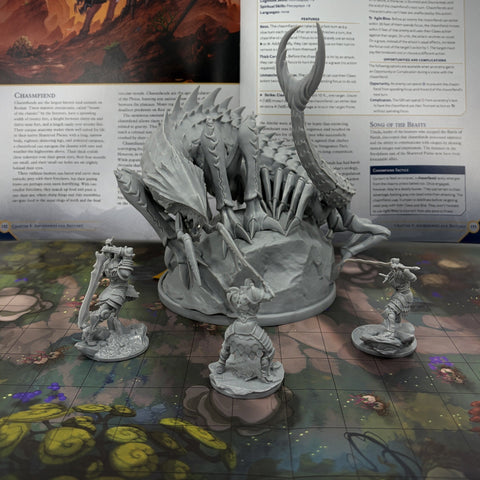
Every great RPG campaign starts with a willing game master (GM). From tense dungeon crawls to excellent roleplaying moments, they breathe life into the game and help the players experience the adventure they are looking for. Every veteran GM started somewhere, and new GMs learn with every session they run.
When I first started playing TTRPGs with my brother, we took turns GMing, and thus we each learned skills that serve us on both sides of the table. We pored over the Dungeons & Dragons Player’s Handbook and Monster Manual for hours. Willingness to run the game was enough for me to start, and I had a blast playing even while I was learning the ropes.
What Does the GM Do?
Taking on the role of game master involves extra preparation for every game night and a lot of responsibility during play. As a Cosmere GM, you guide the adventure, control the adversaries, and arbitrate the rules of the game.

The Basic System
The GM sets the scene and then the players describe what they want to do. You decide what skills, abilities, or bonuses apply (including the plot die, a Cosmere RPG–specific mechanic that can raise the stakes on an important roll of the dice). Then the player rolls, trying to beat a number that represents the difficulty of whatever they’re attempting. Success or failure is determined by a player’s dice roll and their bonuses and whether they beat the difficulty class they are rolling against. Many of the first questions you’ll ask about playing the RPG are answered in Brotherwise Games’ How To Play Series of videos:
Rules Referee
The GM decides when it’s worth looking up a rule and when it’s better to keep the game moving. You’re a referee, not an encyclopedia. Sometimes a great roleplaying moment matters more than strict rules—this is sometimes called the “rule of cool.”
Consistency matters a lot here. Players will have an easier time moving past differences between your rulings and the written rules when you apply them consistently. The rules are there to support you, not control the game—but you should still read and use your handbook. Knowing which dice to roll or where to find a statistic on a character sheet will help keep the game moving.
You don’t need to memorize every player ability. Focus first on understanding the core rules of the game. As you run more sessions, you’ll naturally become more familiar with the players’ abilities, and you’ll be able to make more accurate rulings when balance starts to matter—during a tense boss fight, for example. Ideally, you know your playgroup well enough to trust them with the details of their own characters.
Adventure Guide
Familiarize yourself with the adventure you’re running and the characters in the party. Players will often go in unexpected directions, but you can adapt by placing important encounters, clues, or events in their path. Many GMs homebrew their own adventures, writing the story and inventing the characters themselves. Others enjoy premade stories, like Stonewalkers: a continent-spanning adventure for the Cosmere RPG that chronicles the party's journey to restore Taln’s Honorblade.


It also helps to set expectations early. Is the adventure a sprawling journey across the continent of Roshar, or a focused dungeon crawl full of danger and treasure? Will the game emphasize roleplay, intrigue, or combat? Many RPGs—including the Cosmere RPG—support all three pillars of play.
Game Master and Monster Wrangler
As GM, you describe scenes, present challenges, and determine the consequences of the players’ actions. The players control their characters, but you guide the world and the direction of the adventure. You also portray the people and creatures the players encounter. This includes roleplaying non-player characters (NPCs) and controlling monsters during combat. Knowing the flow of combat encounters or roleplay conversations comes with time.

Failing Forward
You’ll spend most of your playing time narrating the scenes of the adventure and helping referee the players’ responses to those scenes. To run the scenes, you need to know them, so understanding the structure of an adventure is helpful. Keep it simple: Have a beginning, a middle, and an end. Players go on a quest, the quest hits a complication, and they scrape past with their lives (and hopefully some treasure) before recovering a while so they can do it all again.
Know that no matter how much you prepare beforehand, no amount of prep survives contact with the players. You could have a whole city mapped and know the stat blocks for every enemy you plan for the players to fight, but you’ll still end up navigating player decisions that you didn’t account for. You might spend weeks preparing, but it will never be enough to completely anticipate player agency. They’ll pick fights with NPCs who were meant to be allies, they’ll become inordinately infatuated with throwaway NPCs, and they will flounder with puzzles designed for schoolchildren. Time to learn to roll with the punches and embrace adventures going in directions you couldn’t foresee.
That said, you can move the adventure forward even if the players are taking the scenic route to the next encounter. Let’s say they were supposed to meet with a mysterious sponsor who would set them on course to their next adventure, but they started a bar brawl and got stuck in jail. The sponsor could appear to pay their bail, and now the players have another reason to go on their quest—they have to pay back the bail money.
Are players are taking too long preparing to go into the dungeon, wasting precious time before game night is over? Have a monster that they aren’t ready to fight chase them into the dungeon, where the monster can’t fit. This gets them into the dungeon and sets up a monster hunt when they are better prepared to face this fearsome foe.
In your first few sessions, this kind of improvisational pacing can be difficult, but as you gain experience you will be able to tell when the players are just having fun roleplaying and engaging with your world and when they aren’t sure what direction to go for adventure. I love finding ways to surprise my players, and to lean into (or away from) their expectations.
My Best Advice for a New GM
- You will fail, and that's okay. It’s normal that you don’t know every rule or interaction in the game, especially at first. Make a ruling and move on. Your friends will remember the fun adventure, not the mastery you showed over every damage type and combat mechanic.
- Listen to your players! If they’re itching for combat or another style of gameplay, that’s one thing; if they’re uncomfortable with what's happening at the table, that’s another. There are multiple pages of advice about this in the Stormlight Handbook, starting at page 360.
- Have fun! Remember that at the end of the day, you’re playing the game to have a good time.
What Do I Need?
The Stormlight Handbook is the most important resource for you to learn the rules of the game, but you don’t need it when you start. Brotherwise Games has published a number of free resources. These resources include rules and reference materials for players and GMs, pregenerated characters of all kinds, and most importantly, a starter ruleset you can use to try the game out before diving into the full handbook.
Chapters 9 and 13 of the full Stormlight Handbook are about adventuring and gamemastering, respectively. As I got ready to explore the world of Roshar with my friends, these were the chapters I referenced more than any others. My friends used the character creation resources to make their own heroes, from Crem the warform singer to Ishi, merchant extraordinaire. Their characters started simple, as a bare-bones character worksheet, but as we played through the first session, they discovered more about the stories they were telling with every roll of the dice.
With character sheets, dice, and a grasp of the rules, you are ready to start the adventure. Monster stats and the adventure are a big help too; the Stormlight World Guide has a ton of adventure hooks, monster stat blocks, and more resources that you might enjoy as you start playing the Cosmere RPG. As the RPG expands with additions from the rest of the Cosmere, including Mistborn later this year, these world guides will help GMs run worldhopping campaigns.
You can pick these books up right here on the Dragonsteel store, or at a Barnes and Noble near you.


Further Reading
There are many ways to learn how to run TTRPGs, and further reading on any of these themes might help:
- Beginner’s Guide to GMing — General tips for someone learning to run the game.
- You Want To Become A DM/GM? — A myth vs. reality breakdown for new GMs.
- Five Room Dungeons — Dungeon structure is adventure structure; five room structures are a great place to start.
YouTube also hosts a huge community of RPG players and game masters. Some of my favorite channels for aspiring gamemasters are listed here:
- Matt Coleville — One of my favorite GM teachers, his series Running the Game is fantastic.
- How to be a Great GM — This channel is a goldmine of advice and experience.
- Critical Role — Watching the flow of D&D can be a great way to figure out the flow of RPGs. (You don’t have to be Matt Mercer to have a great time.)
Good Luck!
I love running RPGs for my friends. From countless hours of Dungeons & Dragons to recent escapades with the Cosmere RPG, some of my best memories with my friends happened at game night. From consecutive natural twenties to near total-party kills, the thrills never end.
I hope you take the jump and run a session for your friends. I can’t promise that it’ll go smoothly, but I can wish you good luck. And have fun!

 https://www.dragonsteelbooks.com
Comments (3)
How do the Stormlight miniatures work with a 1 inch grid map, when the bases of the Stormlight miniatures are 1.25"?
Most groups use a grid of 1-inch squares. This size works with the Stormlight miniatures as well as most commercially available roleplaying miniatures.
Thanks for the advice! I’m from Argentina, we got the cosmere trrpg books this past weeks and I’m truly excited to run Bridge 9 for my friends! It’s such a great adventure to start learning the mechanics!
There’s also a great community of people on YouTube doing actual plays of the Cosmere RPG that people can watch for inspiration! My personal favorite is the Shard of Opportunity, who also have a GM advice show called Complicated Opportunities!