
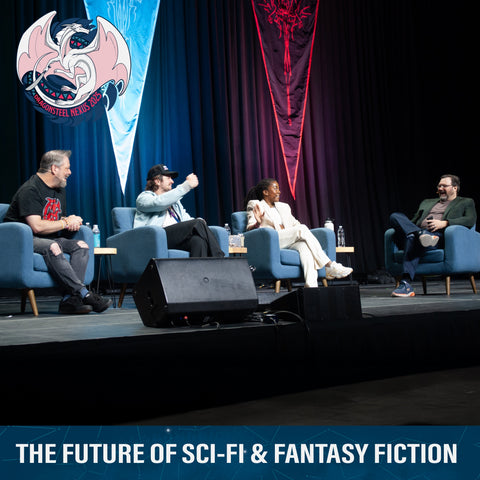
DSNX25 has a stacked list of featured guests, and many of them joined Brandon Sanderson yesterday for an incredible discussion on the future of sci-fi and fantasy. Pierce Brown (author of the Red Rising series), Tomi Adeyemi (author of the Children of Blood and Bone series), and Matt Dinniman (author of the Dungeon Crawler Carl series) made up what Brandon called “the council.” The council predicted upcoming trends, voted to banish their least favorite tropes, lobbied each other to bring their chosen magic to life, and had a thoughtful conversation on the landscape on the horizon.
Yeah, it was as epic a panel as it sounds. We’ll have the whole thing on the YouTube channel for you soon, and will update this post with the link when it’s live.
For now, though, we’ve got the highlights for you.
If You Could Bring One Thing From Sci-Fi/Fantasy to Life...
After the council settled in, Brandon opened up our first debate: If you could snap your fingers and make one piece of sci-fi or fantasy tech real, what would it be?
Tomi Adeyemi didn't hesitate. "The Death Note," she said. "And I think I would be the most comfortable with being the person to hold it." (I agree, but that’s neither here nor there.)
Pierce Brown, ever the political philosopher, offered a drinking game he likes to play: Ask drunk people what three laws their civilization would have if they were an autocrat. "Be afraid of anyone who has too fast of an answer." Seems wise.
His actual pitch, though, was Altered Carbon's sleeve technology—specifically the ansible version where consciousness transmits across light-years to a new body rather than relying on faster-than-light travel.
Tomi was unimpressed. "Isn't that just birth?!" She paused for effect. "DEATH. NOTE. Respectfully."
The audience lost it. Brandon said: “I’m terrified right now.”
The Author-Reader Relationship Has Changed Everything
"I barely knew what Robert Jordan looked like," Brandon said. "I barely knew anything about him. I knew the bio in the back and the tiny picture." He contrasted that with his own career: "Now, people know what my favorite food is, they probably know what I had for breakfast."
It's a shift that shaped his entire trajectory. Early in his career, he'd show up to signings with more popular authors and have three times the line. When they asked what he was doing differently, he'd say he just posted on Twitter. "They were like, what's Twitter?"
For Tomi Adeyemi, this closeness has been transformative in ways she didn't expect. "When you dream of being an author, you're not dreaming about the people you meet. You're mostly thinking about how much you want to write stories, and how you'd give anything to pay your rent and buy pizza off of your stories." But now? "You read this book and you're here? It's special. It's really special."
But there's a tension she's had to navigate: "My art is my art. What I do when I'm writing my stories is completely mine." She paused, then offered one of the most poignant reflections of the panel: "I never get to hold the baby. Being on the edges of the subconscious, trying to make the prose right, trying to do something that's never finished—and then by the time it's finished, it's not mine anymore. Once it became something I could hold, poof, now I can never hold you."
Brandon built on that. "I always say that until a book is read, it isn't finished." He painted the picture of a book as a clay figure until it reaches a reader's hands—and then it comes to life. Readers add that 10–15% that makes the story as unique as a fingerprint. Though, he added: "When I finished Wheel of Time, people would ask if I was happy the books were out, and I'd say yes, but I was the only person not able to read a new Wheel of Time book that year."
Pierce Brown offered his own metaphor: When you're a kid building a fort, the more friends who show up, the more real the fort becomes. "I don't like social media," he admitted. "I love face-to-face interactions. I love conversations. I love being able to have a couple of beers in me—maybe six—and say, why is that your favorite character?" He described that shared space of two people who both resonate with a character or a story as relief and excitement wrapped together. "It's getting to share that same exultation."
Matt Dinniman offered a different perspective. Members of his Patreon actually have the opportunity to vote on what should happen next in his writing process, making them an integral part of the creation of the series. “It makes it so much fun for me,” he said. “They [the fans] have fundamentally changed the course of the series a few times now.”
That’s a level of interaction that authors of the past never could’ve imagined.
Predicting Trends (Or: Why You Can’t Really Predict Trends)
"In the business, we know that you can't really guess at trends," Brandon said. "We're going to try anyway." He set the stage with a story: Sometime around 2001 or 2002, he attended a convention panel where editors discussed upcoming trends. "This was at a very fancy convention, and they said vampires are dead. And they laughed. They said Anne Rice killed the vampire genre."
He paused. "Guess when Twilight was published?"
Despite that cautionary tale, the council had observations—less predictions than recognitions of shifts already underway. Book series are growing up with their audiences now, maturing from YA into adult territory. The Tolkien-esque template no longer dominates the way it once did. And LitRPG is exploding.
Matt Dinniman floated "science friction" as the next big thing. In other words, romantic sci-fi. (Side note: CAN SOMEONE PLEASE MAKE THIS HAPPEN?!)
Matt continued with some thoughts that come from his personal publishing experience. "We're seeing so many more outside-the-box things. For the longest time all fantasy was sword and sorcery, and now we have Gideon the Ninth. Which is incredible and amazing and totally out there." He couldn't publish Dungeon Crawler Carl traditionally; he had to go the self-publishing route. "The audience is deciding what gets published now. Things are back in our hands. We get to decide what makes it on the shelves."
Pierce Brown connected this to the broader cultural moment. "I think it stems from the death of monoculture. There was a certain acolyte to the monoculture that is the gatekeeper." He noted that when they all started writing sci-fi and fantasy, it was still somewhat looked down upon within publishing houses themselves. "Now that publishing houses are counting on sci-fi and fantasy as 50% of their bottom line, there's this opening happening in the industry."
Pierce and Matt agreed on a prediction that absurdism is coming back. "I think the retro '50s are going to come back," said Pierce. And his wildcard for the next big YA trend: angels. (Again, PLEASE?!)
Trends They'd Kill (Or At Least Maim)
Brandon turned the question around: Which trends would they banish?
Pierce Brown had his (very self-aware) answer ready. "A lower [ranked character] infiltrating higher military ranks." For what it's worth, the council ruled that this trend stays. Rightfully so!
Tomi Adeyemi went straight for the jugular: "Female protagonists who don't know they're pretty because they've never looked in a mirror."
Then Pierce and Tomi found common ground, speaking almost in unison: "Ample."
The word hung in the air. No further explanation needed. "Ample" had overstayed its welcome in fantasy prose, and the council had spoken.
What They Want More Of
Matt Dinniman had a counterpoint to the "chosen one" fatigue that's been building in the genre. "I want to amplify the trend that there's nothing special about the main character. I want to read more stories about normal people that rise to the occasion."
It's a thread running through his own work—and increasingly, through the stories readers are gravitating toward. Not the prophesied hero or the secret royal, but someone who simply decides to show up. We love you, Carl.
Cover Trends: A Democracy
Brandon's final question: If they could vote on a cover trend, what would it be?
Matt Dinniman had a proposal that made everyone uncomfortable. "Extreme close-up on the face of the author."
There was a beat of horrified silence.
"Please," Brandon said. "Other ideas. Someone save us from that idea."
Tomi Adeyemi laughed. "My book is called Children of Blood and Bone, so I'm making fun of myself here, but for a while every single YA fantasy book was something of blood or ash or bone or death or something." She paused. "But I like a good word trend." (AGREED. Maybe that one is more than a little tired at this point, but I’m ready for another good word trend, too.)
Pierce Brown went in the opposite direction from Matt's nightmare vision. "Going back to Suzanne Collins kind of covers. Simple covers. Something more stark."
Clean. Minimalist. Let the title do the work. The council seemed to agree. I love a good maximalist cover, but cannot deny the elegance of a cover with stark contrast.
The Votes Are In
The council has spoken, and honestly, we're just hoping the next trends prediction includes more panels exactly like this one. If you want to catch every moment, keep an eye out for the full video on our YouTube channel. We'll update this post with the link as soon as it's live.
Until then: May your protagonists know they're pretty, may "ample" rest in peace, and if it can’t be with Tomi Adeyemi, may the Death Note stay firmly in fictional hands. Respectfully.

 https://www.dragonsteelbooks.com

Comments (5)
This was a fun read thank you!
Yes, Just A Dude (haha) is correct! They were talking about how many writers use the word “ample” in exactly that context. The council wanted more thoughtful description when it comes to characters. The full panel will be up by the end of the month and linked in this post, and that section alone is worth coming back and listening to. 😂
I assumed it tied into the previous complaint about female protagonists and their beauty. Ie, ample bosom.
I don’t even know what “Ample” means in this context. I know the traditional definition of the word, but what is it that they want less of exactly?
Google just gives me the “plentiful, enough” etc. definition, nothing as to what they might be referring to here.
Any help would be appreciated.
Anyone wanna fill me in on why “ample” is banned now? What’s wrong with it? I’m not trying to start anything, I’m trying to learn what the gripe is.