
The Wheel Weaves…
“You want stories?” Thom Merrilin declaimed. “I have stories, and I will give them to you. I will make them come alive before your eyes.”
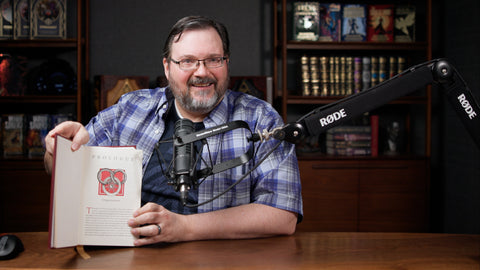
As we celebrate the release of Dragonsteel’s The Eye of the World leatherbound, I sat down with Brandon Sanderson to talk about his Wheel of Time origin story, exploring how he discovered the series and became a fan, nearly two decades before he would help finish Jordan’s fantasy epic.

Brandon’s Wheel of Time Origin Story
JACK: We’ve heard you talk about how your career is tied to Robert Jordan’s legacy, but I want to explore your history with the Wheel of Time. Before Jordan passed, you were already a Wheel of Time fan—what was your reading journey from Dragonsbane to The Eye of the World?
BRANDON: I became a pretty big reader in [1989]. And the thing I always say is, in hindsight, I had started to look for series that I could discover on my own, because before then, everything that I’d found had been handed to me. I’d read Dragonsbane, I’d found some books in the library with the help of a librarian, I’d been handed The Sword of Shannara that summer by a church leader, and I had read through all of those.
I’d had David Eddings handed to me by another friend who said ‘Oh, you should read this.’ And so I had started; I’d gotten through all the books that all my friends and family and librarians had handed to me, and I’d started going to bookstores. And the bookstore that I went to was Cosmic Comics in Lincoln, Nebraska.
You say ‘Cosmic Comics?’ Well, Cosmic Comics had its own section for books, and it only sold paperbacks, no hardcovers. They had a punch card. If you bought 10, you got one for free.
JACK: Very cool.
BRANDON: That’s pretty cool, huh? I carried that punch card in my wallet.
I was so happy every time I got to turn one in and get a book. And I’d been buying the books that people had recommended. That’s where I’d gotten my David Eddings books and my Anne McCaffrey books—books that the library didn’t have, and things like that.
I can still remember the first book that I went into a bookstore and bought was an Anne McCaffrey book, because my school library didn’t have them all. And so I went and bought one, and I kept that book for many years. So I started going to Cosmic Comics, and I started buying books.
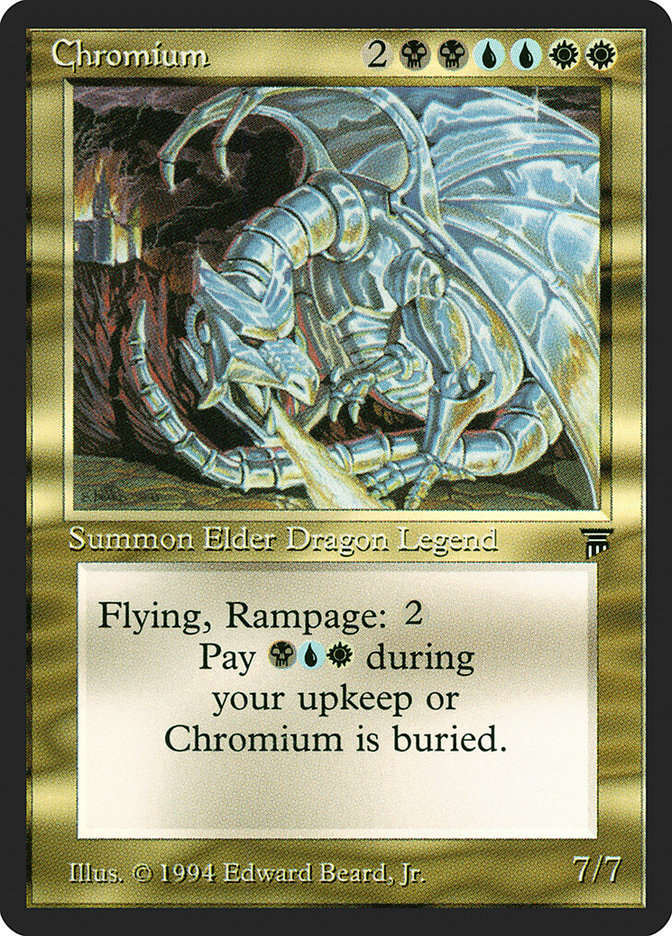
This is where I bought my first pack of Magic cards. Legends, when it came out.
And I would always go in and they’d have the new releases shelf right in the door. You’d walk right in the door, and just to the right are all the new books that have come out.
And on that shelf, it was actually on the bottom for some reason. I don’t know why it was on the bottom shelf. His name is “J.”
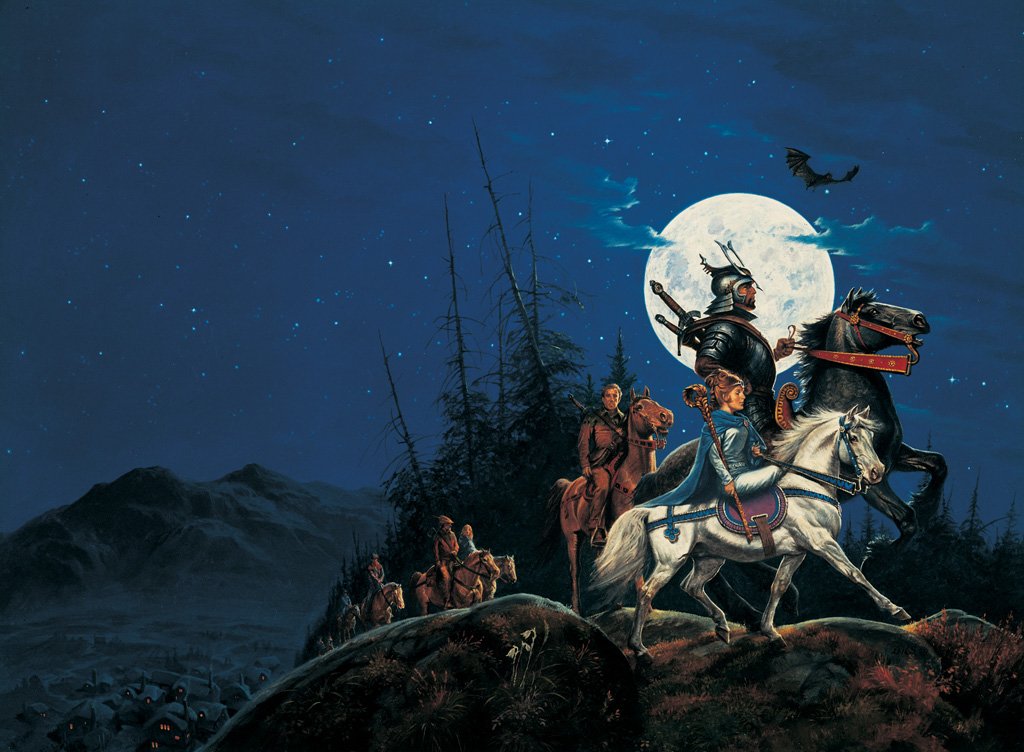
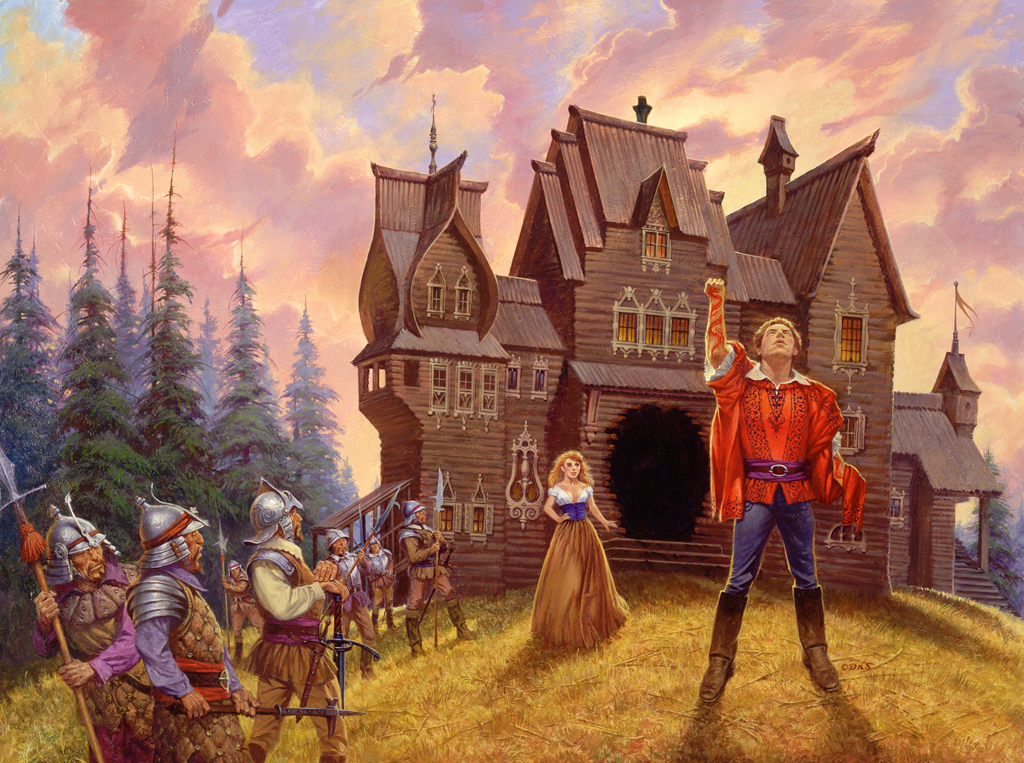
It should have been in the middle, but it was on the bottom, the very, very bottom shelf, was this big, thick book, The Eye of the World. And I thought ‘Ooh, that’s a big book.’ And I had learned by then that you like the big books because they only cost a dollar more than the small books, but they were twice as long. And so I was always on the lookout, because I didn’t have a ton of money back then for books, and I was always on the lookout for the big paperbacks. I remember picking up the Wheel of Time and that gorgeous Darrell K. Sweet painting on the cover.
Still, to this day, I think Darrell Sweet’s best piece is The Eye of the World cover. I took that book home, and I loved it. And I felt a certain possessiveness over it, because I’m like, oh, this little book that I discovered—little did I know that everyone was discovering it at the same time.
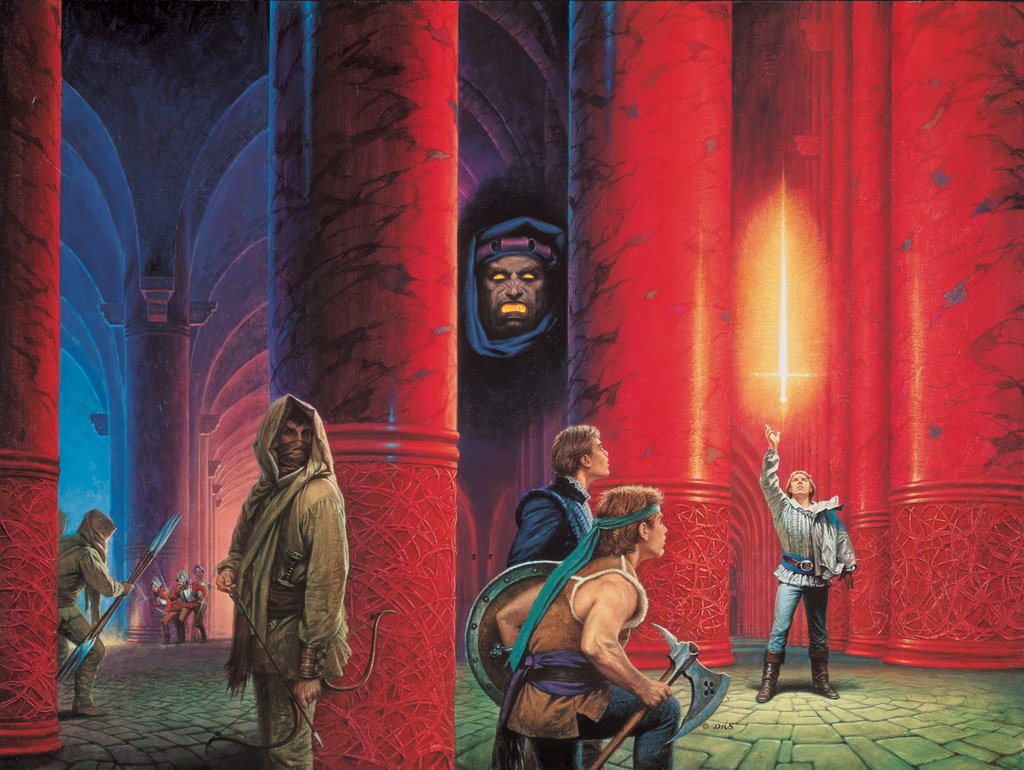
But when the second book came out, I was really excited, and I got that. And the third book is when I knew something was happening, because even Cosmic Comics got in the hardcover, which they never did… they got hardcovers of The Dragon Reborn. And I bought one.
[It’s] the first hardcover I can remember buying with my own money. The others I got for Christmas presents. I bought that [one]. And I felt like, “it’s because of my patronage that this book series has taken off.” Now everybody knows. And then at college I went online and I found out that everyone loved the Wheel of Time, they were all talking about it. And it wasn’t this little series that could. It was the dominant force in fantasy by that point.
But I’d always kind of imagined it was this little indie series that I loved that no one else had ever heard of, because I didn’t have a lot of fantasy reader friends.
JACK: So at that time, what did the Wheel of Time bring to young Brandon Sanderson that was unique for a fantasy franchise?
BRANDON: Yeah, so what did the Wheel of Time do? Part of it is: it is me. It’s the magic system.
I’d been reading a lot of fantasy at that point, and I do love a lot of these fantasies. But the ones I mention frequently, like a lot of the Anne McCaffrey [books], those are, we call them science fiction, but there’s a very loose magic system to that. Obviously Tolkien, it’s a little bit vague what Gandalf can do and what he can’t do.
Sword of Shannara is kind of the same way. Wheel of Time had the Aes Sedai and the One Power, and the way it worked was a step more toward a really rule-based, intricate magic system that felt, in a lot of ways, more real for that reason. I think that people, if magic were real, would approach it and figure it out the way that [the Wheel of Time characters] were figuring it out.
You would have weaves. You would have things that you know you can do, even if there’s a lot of questions [about] the magic. I really like that.
I really liked that it was an ensemble cast, and that I liked the whole cast. And that was a distinctive thing from a lot of what I’ve been reading, where it was just one hero on an adventure. I really bonded with Perrin a lot in that first book.
But I also felt like Moiraine was more interesting than a lot of the mentor figures that were in other [books]. As much as I think, “Argh! Moiraine!” But that was good, because she felt more like a real person than perhaps, no shade at Allanon and people like this, but [Moiraine] did feel like she was flawed in an interesting way.
And as the books progressed, they became more and more about the setting and the political intrigue and things like this, and a little less quest fantasy. And as a reader[s], we often talk about how Harry Potter readers would grow up with Harry Potter becoming more dark and more intricate. Well, that happened with Eye of the World in a different way: the Wheel of Time books were becoming less about, “we’re on a cool adventure,” [and more] the fate of the world is at stake, and in order to deal with the fate of the world, you actually have to work with the politics of all these kingdoms. And as fantasy was growing up in a lot of ways, I was growing up.
And it’s no surprise that Game of Thrones came along, where political intrigue became the forefront rather than the adventure, at about the same time that Wheel of Time did the same thing.
But Wheel of Time had all that fantastic world building, all of that lore, all of that epic fantasy feel. And so it’s really when [books] four, five, and six happened that the Wheel of Time became my favorite series. If you would have asked me during the Eye of the World, Great Hunt era, I probably still would have said Anne McCaffrey or David Eddings or one of these others. And it was book four, where I’m like, no, this is doing something that I like.


I don’t necessarily think it’s, it’s not like qualitatively, like, “Oh, this is better than Anne McCaffrey.” I don’t think it is. I think they’re both fantastic masterworks in the top tier. But what I love the most—Wheel of Time became that as it progressed.
And those books, four, five, and six, it’s like, “this is what I want to do! This is what I’m absolutely in love with. This is where I am.”
I think that’s where I first recognized what I wanted to be as a writer.
JACK: That’s so cool! And now you’re about to release the collector’s edition of The Eye of the World.
BRANDON SANDERSON: Yeah.
JACK: What was the first collector’s edition of a book that you went and you wanted, personally, to own?
BRANDON: The first kind of real collector’s item that I bought was The Art of Michael Whelan. I asked for it for Christmas. It was a specialty book that you had to order. The bookstores didn’t carry them. And it was $60. This is in the early ’90s. $60 for a book was a huge amount. And I’d never bought a book on that level or anything. But that’s what I wanted.
I wanted this really nice thing. I still have it on my shelf in my office back home: The Art of Michael Whelan. Fantastic book.
All of his book covers and then a lot of his fine art pieces. And I’ve said many times before that that’s where the first inspiration for Elantris came from; I was looking through some of his fine art pieces and imagining the stories that would go along with the books, the books that hadn’t been written yet, about things that he’d just come up with in his imagination. That’s the first collector’s item I can remember getting.
Leatherbounds were not really a thing that you could get a hold of very easily, particularly in Lincoln, Nebraska, back in the ’90s. I heard about Wheel of Time leatherbounds, but the first one I actually managed to get was when they sent me one because I wrote them. And I think that’s the actual first leatherbound book that I ever owned, because deluxe editions—special editions—they just weren’t a thing back then.
In fact, the reason my company kind of exists as it does right now is because I got that leatherbound, and thought, “This was ridiculous that I couldn’t get a hold of the earlier ones.” And no shade, but the edition is really boring. To make a leatherbound they just took the regular book, they then rebound it with leather—but there’s not even really a symbol on it. And it’s still a precious possession. But if you open it up, it has the same end pages as the commercial edition, and it has the exact same contents. There’s not even new drop caps or new maps or anything.
And this was $250. This is $250, and that’s in 2010 money. And this is not the publisher trying to rip you off. There just was not an industry for these.
These were super expensive for them to make. I think Tom told me that these they did for fans, they actually cost $125 to print each one, and then they sold them for $250, with the bookstore taking a 45% cut. And so Tom told me, “we make, like, five bucks.”
This is why he gave me my rights back for free. He said, “We make less on a leatherbound than we do on a hardcover, or maybe like $1 more. It’s infrastructure.”
People wanted these, but there’s this problem where people want them, but not enough people want them for the bookstores to be willing to risk having a $250 product on the bookshelf. I would go into bookstores and ask, “do you have the leatherbound?” They’d say, “We’ve never even heard of a Wheel of Time leatherbound. Who buys Wheel of Time leatherbounds?” So this is why, when we did ours, I said, all right, we’re going to change this.
So you can see I said, “all right, let’s make the book that I thought I was buying.”
Buying? They gave me this for free because I wrote the book. But I did get one for free. But let’s give people what they want.
Let’s get actual artwork on the cover. Let’s make the spine not just look like a textbook—look like something really cool. And then when you open this thing up, let’s make sure that you see immediately that there’s going to be new artwork in this.
It’s not just the edition that you’re used to. Let’s luxury-ify everything about this book, gold on the outside rather than the standard white, and full art, paintings in it, and things like that. Let’s really do the book that I thought I was getting.
Man, that’s a hefty book. But that feels so cool.
So what was my first leatherbound? It was this. It was actually The Gathering Storm. We have The Towers of Midnight one here. But it was The Gathering Storm leatherbound. I feel very proud of this, I feel like I helped change this market.
Now, there were other people around that were starting to make leatherbounds and had been for a little while. If you knew what you were doing, you could get them on the internet by then. Really nice editions done by several really cool presses.
But the mass ability to know where to get these was not there. I feel very proud of the way that deluxe editions and luxury editions are now a major part of the market. And a lot of authors are making their income off of these things.
And so I feel very proud of my place in that. And I feel like I finally get to have the book that I wanted back in the late ’90s. You have to come to me. [It] won’t be in the bookstores, but there it is.

JACK: Last question from me for the time being: Why should someone who loved the Stormlight Archive but hasn’t read Robert Jordan yet start reading the Wheel of Time?
BRANDON: Why should you read the Wheel of Time? Well, the Wheel of Time is excellently written. Robert Jordan’s mastery of prose is unparalleled in writing. I think he’s one of the best with viewpoint and with just descriptions that we have.
The Wheel of Time feels kind of luxurious in its writing compared to a lot of contemporary sci-fi/fantasy. You know, those of us who write like that, we do it on purpose. But these ’90s throwbacks like [the Wheel of Time] and Guy Gavriel Kay, there’s just a feel to them that I really like that you might enjoy as well.
They’re more in the Tolkien tradition. The other reason is the Wheel of Time is a finished, fantastic fantasy epic. And there aren’t actually very many of those out there that you can read.
If you love Lord of the Rings and you want to read a fantasy epic that is done, your options are Wheel of Time and Malazan—that’s kind of it. These are huge endeavors. And I can tell you, it ends really well.
ALL: [Laughter]
BRANDON: It has an ending. It is a good ending. And I wrote it. The Eye of the World is a great book, and the series gets stronger and stronger the further it goes. And you get to watch fantasy grow up in a lot of ways by reading this. Tolkien was already grown up.
But the genre got to grow up essentially through the Wheel of Time. It’s fantastic characters. It’s fantastic world building. It’s fantastic writing. I mean, what is there not to love?
The first book’s going to read a little Tolkien-inspired. It’s a quest fantasy with a bunch of people running from a village chased by dark, shadowy figures and things like that. You’re going to feel the Tolkien influence in this one. And then the second book is going to feel a step different. You’ll say, “Oh, the world building’s different.”
This is different. And then by book three the main protagonist is so different from anything you’d see in a Tolkien-inspired thing. And then book four is into the deep world building.
If you like the Stormlight Archive style of world building, book four is your jam. You’re going to get there and say, “Oh, I get why Brandon loves this book.”
JACK: Thank you so much.
As The Wheel Wills
My Wheel of Time journey is very close to Brandon’s. My earliest days as a reader were defined by my parents' bookshelves and the school library. Bedtime stories about Bilbo Baggins and William Wallace piqued an appetite for adventure that would grow to define me over the years. I began to discover my own tastes as I pored over stories of rangers and monsters, heroes and old wizards whose tales were well beloved, covers tattered and pages dog eared.
This taste for adventure grew, and with it my appreciation for longer and longer stories. The bigger the book, the longer I had before it was all over (an appreciation that many book lovers develop, but that felt like it belonged to me at twelve). As I burned through the more digestible stories, the thousand-page epics at the top of the shelf beckoned me. Chief among them stood a big blue book. A white horse and a beautiful rider, a black horse and his armored rider. The familiar lights of the city fading behind them as their journey takes them out the door and onto the wide road ahead.
My parents’ copy of The Eye of the World is where I discovered Rand and Moiraine and the heroes from the Two Rivers, and joined the many fans of Robert Jordan around the world. But my parents only had the first book and the school library’s copies were perpetually checked out—the waitlist for the rest of the series stretched across an entire academic year. As the other fantasy readers and I took our turns, we talked about the series in the mornings before school, and together we started pushing into the wide world of fantasy fandom. Robert Jordan helped propel me from the world of children’s literature to the broader world of fantasy and literature in general. These books create community, belonging, and a great deal of joy. I am very excited to jump back into Jordan’s world and finish the series.
Let us know about your favorite Wheel of Time memories in the comments, and if you are ready to get your hands on your own leatherbound edition of The Eye of the World, you can head to dragonsteelbooks.com. You will also be able to watch the full interview on Brandon's YouTube channel.

 https://www.dragonsteelbooks.com

Comments (4)
I started reading the wheel of time series when I was 18, it’s been 25 yrs now and I re-read them at least once a year. I take my time and make the series (prequel plus the 14 books) last me months, usually I can read 30-60 books a month depending on the books but I don’t like to rush this series so it takes me closer to 4-6 months. I have all these books on e-books as well as paperbacks with some extra copies of the paperbacks since I haven’t found them all since not done unpacking after I moved.
I wish for more books to build out the series, maybe one like an after story, and maybe some spin-offs because there is so much potential that I can think of and wonder about. I was also unable to find bookmarks to match the series – so many books have bookmarks and ornaments and merch for them like Harry Potter: I would buy Wheel of Time merch. I’m going to check out more Brandon Sanderson books, as he did a great job with Robert Jordan’s series, although I do hope he arranges to continue adding books to the world of Wheel of Time
Hey Spensur!
We are getting the Cognitive Realm set up with mentions on the newsletter but we mostly shout out new posts on Dragonsteel social media channels. Thanks for the read, and I look forward to seeing you here again!
(And Adam says hi!)
I also felt like I “discovered” The Wheel of Time, I recommended that book to every fantasy nerd I knew and created a few new ones in the process. My bookstore was Fine Print Books, you got a $5 gift certificate for every $100 spent, I was such a frequent customer they just kept my receipts for me in an envelope behind the counter. Sadly, Fine Print didn’t have a great comics section so I had to get my mother to drive me to Yellow Springs every week or two for a trip to Darkstar for my comic book fix.
Hi guys, and especially Adam. I’m a huge fan of this stuff, Cosmere and Wheel, and I was unaware of the existence of these articles collected in the Cognitive Realm. Is there a place these are released when new ones are published? Am I not subscribed to a delicious emailing list that I should be?